

12 October, 2026
Nigeria Air Force Plane Crash: What It Teaches Us About Business Continuity
Nigeria Air Force Plane Crash: What It Teaches Us About Business Continuity
Nigeria has spent the past few days searching for answers after a Nigerian Air Force ATR-42 aircraft crashed near Igbokoda in Ondo State on 5 October 2026 during a routine mission from Benin City to Lagos. The incident has understandably pushed searches such as “Nigerian Air Force,” “air force crash,” “Nigeria Air Force” and related queries sharply upward. The President has ordered an investigation and declared three days of national mourning. The cause of the crash has not been established, and it should not be guessed at while the investigation is ongoing.
There is, however, another question worth asking – especially if you run a company, manage operations, work in risk and compliance, or are responsible for keeping critical services available: when a serious disruption happens, what allows an organisation to keep functioning?
That is where business continuity comes in.
What happened in the latest Nigeria Air Force plane crash?
The Nigerian Air Force said the aircraft was an ATR-42 operating a routine mission between Benin and Lagos. The crash occurred around the Igbokoda area of Ilaje Local Government Area, Ondo State. Initial reporting gave different figures for the number of people on board; later reporting from the Air Force and international news agencies clarified the toll. For readers following the story, the most important point is that an investigation is underway and the incident triggered an immediate search-and-rescue response.
That sequence matters beyond aviation. In any organisation, the first response to a serious incident is about protecting people, containing the situation, communicating and coordinating the emergency. The next question is: how does the organisation continue critical operations while the disruption is being managed?
An emergency response is not the same thing as business continuity
This distinction is often missed. An emergency response plan tells people what to do in the immediate crisis. Business continuity goes further: it asks how critical products and services will continue at an acceptable level during disruption, how they will be recovered, and how the organisation will learn from what happened.
The International Civil Aviation Organization makes the distinction clearly. It says aviation stakeholders need emergency response and contingency plans for rapid response and restoration, while business continuity plans go beyond immediate mitigation to build resilience and support recovery. In other words, the emergency may last hours; the business consequences may last days, weeks or much longer.
What would happen to your business if one critical operation stopped today?
Imagine that a key supplier cannot deliver. Your main office becomes inaccessible. A cyber incident takes your systems offline. Flooding blocks access to a facility. A key member of staff becomes unavailable. Or, closer to the aviation example, a disruption suddenly affects the movement of people, goods, documents, equipment or customers.
A resilient organisation should not be asking these questions for the first time after the disruption. It should already know which activities are critical, what level of service must be maintained, how quickly each activity needs to recover, who has authority to activate the response, what resources are required, and how the organisation will communicate.
5 business continuity lessons hidden inside an aviation disruption
- Know what is truly critical. Not every process needs to be restored at the same speed. A Business Impact Analysis helps an organisation identify critical activities and understand the consequences of disruption over time.
- Decide recovery priorities before the crisis. A continuity plan becomes useful when it contains clear priorities, responsibilities, dependencies and recovery targets – not just a list of emergency phone numbers.
- Build alternatives for single points of failure. A plan that depends entirely on one supplier, one person, one location, one system or one communication channel is fragile. Continuity planning should address dependencies and workable alternatives.
- Test the plan before you need it. A document can look perfect and still fail under pressure. Exercising, simulations and internal audits expose gaps while there is still time to fix them.
- Treat lessons learned as an improvement loop. The real value of a continuity system is not only surviving the incident. It is using evidence from exercises, disruptions, audits and reviews to make the organisation more resilient next time.
So, where does ISO 22301 fit?
ISO 22301:2019 is the international standard for Business Continuity Management Systems (BCMS). It gives organisations a structured management-system approach for preparing for, responding to and recovering from disruptive incidents while continually improving their continuity capability.
The important word is system. ISO 22301 is not simply about writing a business continuity plan and saving it in a folder. A functioning BCMS connects organisational context, leadership, planning, resources, operational continuity arrangements, performance evaluation, audits, management review and continual improvement.
For an organisation looking at the lessons of an aviation incident, that translates into a practical chain: identify critical activities -> understand their risks and impacts -> decide continuity and recovery strategies -> document response and recovery arrangements -> test them -> audit performance -> improve what failed.
Why an ISO 22301 Lead Auditor matters
A Lead Auditor is trained to assess whether a Business Continuity Management System actually meets the applicable requirements and whether the organisation’s arrangements are working in practice. That requires more than reading a policy. Auditing involves planning the audit, gathering objective evidence, evaluating conformity, documenting findings, reporting results and following up corrective actions.
This is especially relevant when an organisation wants to move from ‘we have a plan’ to ‘we have evidence that our continuity system is structured, tested and improving.’
ISO 22301 Lead Auditor Training in Nigeria: Train with Training Heights
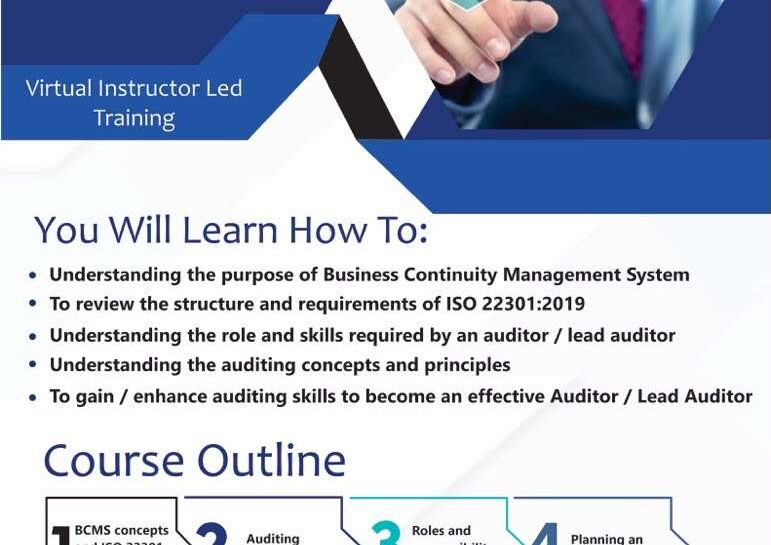
For professionals who want to build practical BCMS auditing skills, Training Heights is offering an ISO 22301 Lead Auditor (Business Continuity Management) programme. The current course flyer lists a virtual instructor-led class from 27–30 October and a fee of N500,000, inclusive of certification.
|
Course |
ISO 22301 Lead Auditor – Business Continuity Management |
|
Date |
27-30 October |
|
Format |
Virtual Instructor-Led Training |
|
Fee |
N500,000 – inclusive of certification |
|
Training Heights |
+234 806 726 9749 | victoria.oyedeji@trainingheights.com | trainingheights.com |
The programme is designed for professionals who need to understand BCMS auditing, audit planning, reporting, corrective actions and ISO 22301 requirements. That includes internal auditors, risk and compliance professionals, business continuity practitioners, management system consultants, quality professionals and others responsible for organisational resilience.
Ready to turn business continuity from a document into a capability? Contact Training Heights to reserve a place or request an invoice for your organisation.
What is the difference between business continuity and disaster recovery?
Disaster recovery is often focused on restoring technology, systems, data or IT services after an incident. Business continuity is broader. It looks at how the organisation continues its critical products and services across people, processes, facilities, technology, suppliers and other dependencies. Disaster recovery can therefore be one component of a wider business continuity capability.
What should a business continuity plan contain?
At minimum, the plan should connect critical activities to clear response and recovery actions. Depending on the organisation, that can include activation criteria, roles and decision rights, communication arrangements, recovery priorities, resource requirements, dependencies, alternative arrangements, technology recovery procedures, stakeholder contacts and return-to-normal procedures. The plan must also be exercised and maintained so it remains useful.
Is ISO 22301 only for airlines or aviation companies?
No. ISO states that its Business Continuity Management System requirements are intended for organisations of different types and sizes. Aviation is a useful example because disruptions can quickly affect connected services and stakeholders, but the same continuity logic applies to banks, hospitals, manufacturers, logistics firms, technology companies, government agencies and professional services.
Which version of ISO 22301 is current?
The published standard is ISO 22301:2019. ISO currently also lists a third-edition committee draft under development that is intended to replace ISO 22301:2019, so organisations should check the latest ISO status when planning implementation or certification.
Final Takeaway
The Nigeria Air Force plane crash is a human tragedy, not a marketing opportunity. But the public conversation around it has surfaced a serious professional question: how prepared are the systems we depend on when something goes wrong?
For businesses, resilience is not proved when everything is working. It is proved when a critical activity is disrupted and people know what to do, decisions are made quickly, customers are protected, essential services continue, recovery is controlled and lessons are turned into improvement.
That is the territory of business continuity management. And that is why ISO 22301 Lead Auditor skills matter.
📞 Spots are limited – don’t miss out!
Ready to Learn?
Take the next step in your career with this course. Enhance your skills today.
🎥 Virtual, instructor-led sessions – Learn from the best, wherever you are.
🌍 Globally recognized certifications – Boost your credibility worldwide.
🕒 Flexible schedules – Learn at your convenience.
🧑🏫 Expert trainers & hands-on learning – Real skills, real impact.
💰 Affordable pricing & group discounts – Learn more, save more.