

26 November, 2026
ISO 22301 Lead Auditor: Auditing Real Business Resilience
When One Critical Supplier or System Fails: What an ISO 22301 Auditor Should Look For
A business can have a continuity plan, a risk register and a folder full of policies—and still struggle to recover when disruption strikes.
The problem is often not the absence of documentation. It is whether the organisation has identified the dependencies that matter, tested its assumptions and built a Business Continuity Management System (BCMS) that works beyond the boardroom.
Consider a company that depends on one supplier, one data centre, one production facility or one logistics route. What happens if that dependency suddenly becomes unavailable? And how would an auditor know whether the organisation is prepared?
These are the questions an ISO 22301 Lead Auditor is trained to investigate.
Why business continuity is about dependencies, not just disaster plans
Business continuity management is about keeping priority products, services and activities running or recovering them within agreed timeframes, when disruptive events occur. The disruption may be a cyber incident, power failure, equipment breakdown, staff shortage, supplier failure, extreme weather or another event that threatens operations.
Recent conversations around critical infrastructure and supply resilience illustrate an important point: strengthening one part of a system can reduce exposure, but concentrating too much activity in a single facility or dependency can introduce new vulnerabilities. Resilience requires organisations to understand both the benefits and the risks of their dependencies.
ISO 22301:2019 provides a framework for establishing, implementing, maintaining and continually improving a BCMS. An auditor’s job is not simply to confirm that a continuity plan exists; it is to evaluate whether the management system conforms to requirements and is supported by evidence.
What does an ISO 22301 Lead Auditor actually examine?
An effective audit looks beyond whether documents have been completed. It examines whether the organisation’s continuity arrangements are coherent, supported and capable of meeting their intended outcomes.
- Business Impact Analysis (BIA): Has the organisation identified critical activities, impacts of disruption and the timeframes within which activities need to resume?
- Risk assessment: Are disruption risks identified, analysed and addressed with appropriate continuity strategies?
- Dependencies: Are key suppliers, people, technology, facilities, information, transport and other resources considered?
- Continuity plans: Are procedures practical, accessible, assigned to responsible people and aligned with recovery priorities?
- Exercises and testing: Has the organisation tested its arrangements, recorded outcomes and used lessons to improve?
- Competence and awareness: Do people responsible for continuity understand their roles and have they demonstrated the competence required?
- Performance and improvement: Does the organisation evaluate BCMS performance, conduct audits, review the system and address nonconformities?
The evidence matters. An auditor may need to follow the trail from a critical activity identified in the BIA, through the chosen continuity strategy and plan, to the results of exercises, corrective actions and management review.
A checklist is useful, but audit judgement is what makes it valuable
Checklists help auditors organise their work, but they cannot replace professional judgement. A completed checklist does not automatically demonstrate that a business continuity management system is effective.
For example, an organisation may report that it has a backup supplier. An auditor should examine whether the supplier can realistically provide the required service, whether the dependency has been evaluated, and whether the arrangement has been tested or otherwise supported by evidence.
Similarly, a recovery plan may specify a target time for restoring an activity. The auditor should examine whether the target is informed by business impact analysis, whether the strategy can support it and what testing or other evidence demonstrates the capability.
That ability to ask meaningful follow-up questions, collect and evaluate evidence, document findings and communicate audit results is central to competent auditing.
Who should take ISO 22301 Lead Auditor training?
ISO 22301 Lead Auditor training can be valuable for professionals who want to audit or assess business continuity management systems, including:
- Business continuity and resilience professionals
- Internal auditors and compliance professionals
- Risk management practitioners
- Consultants supporting BCMS implementation or improvement
- Professionals involved in management system audits
- People seeking to develop their business continuity auditing skills
Learners should ideally have a foundational understanding of ISO 22301 and business continuity concepts such as the Business Impact Analysis, risk assessment, continuity strategies, response options, performance monitoring and exercises.
What will you learn in ISO 22301 Lead Auditor training?
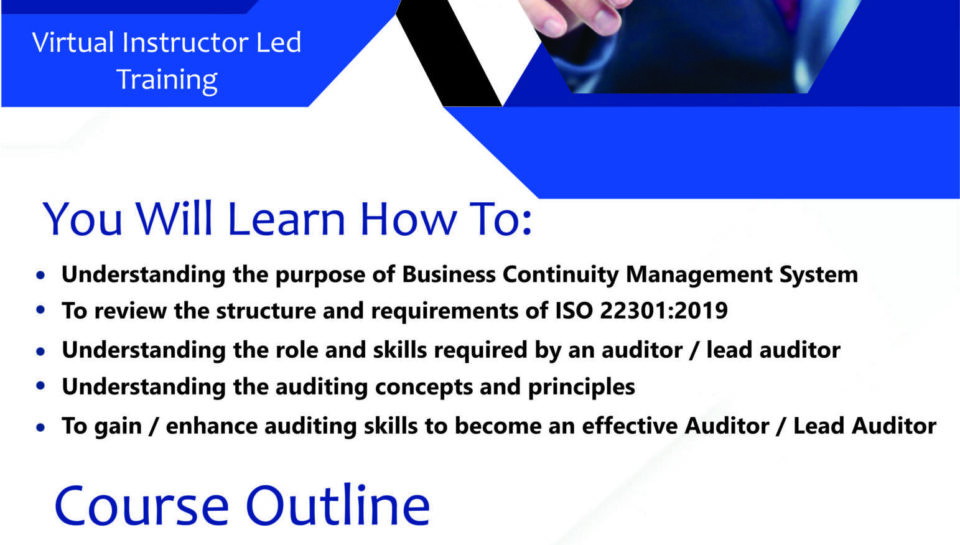
The ISO 22301 Lead Auditor course develops the knowledge and skills required to audit a Business Continuity Management System. Training commonly covers the standard’s requirements, audit principles, auditor responsibilities and the practical stages of an audit.
At Training Heights, the ISO 22301 Lead Auditor (Business Continuity Management) course covers:
- Business Continuity Management System concepts and ISO 22301 requirements
- Auditing concepts and principles
- Roles and responsibilities of auditors and lead auditors
- Planning an audit
- Conducting an audit and gathering evidence
- Reporting audit results
- Corrective actions
- ISO 22301 registration and certification context
Participants will develop and enhance the auditing skills needed to approach BCMS audits more effectively.
Join Training Heights’ ISO 22301 Lead Auditor training
Build your auditing competence and learn how to assess a Business Continuity Management System against ISO 22301 requirements.
Training Heights Limited is offering virtual instructor-led ISO 22301 Lead Auditor training.
- Course: ISO 22301 Lead Auditor (Business Continuity Management)
- Date: 1–4 December 2026
- Delivery: Virtual instructor-led training
- Fee: ₦500,000 (inclusive of certification, as stated in the course flyer)
This training is designed to help participants understand the BCMS, audit concepts and principles, auditor responsibilities, audit planning, conducting audits, reporting results and corrective actions.
Ready to strengthen your auditing skills? Register for the ISO 22301 Lead Auditor training with Training Heights.
Visit trainingheights.com or contact Training Heights to enrol and receive course information.
Frequently asked questions
What is ISO 22301 Lead Auditor training?
It is training that develops the knowledge and skills to audit Business Continuity Management Systems against ISO 22301 requirements, including audit planning, conducting, reporting and follow-up.
What is ISO 22301 used for?
ISO 22301 specifies requirements for a Business Continuity Management System that helps organisations prepare for, respond to and recover from disruptive incidents and continually improve continuity capability.
What does an ISO 22301 auditor check?
An auditor evaluates BCMS conformity and evidence relating to organisational context, leadership, planning, support, operations, performance evaluation and improvement, including business impact analysis, risk assessment, continuity plans, exercises and corrective actions.
What is the difference between a business continuity plan and a BCMS?
A business continuity plan describes arrangements for responding and recovering from disruption. A BCMS is the broader management system that establishes, implements, maintains, evaluates and continually improves business continuity capability.
Who should become an ISO 22301 Lead Auditor?
Business continuity practitioners, auditors, risk and compliance professionals, consultants and other professionals seeking skills in BCMS auditing may find the training useful.
How much is ISO 22301 Lead Auditor training in Nigeria?
Training Heights lists its ISO 22301 Lead Auditor training at ₦500,000, inclusive of certification, according to the course flyer provided.
Can ISO 22301 audits help identify business continuity weaknesses?
Yes. Audits evaluate conformity and supporting evidence, and can identify nonconformities and opportunities for improvement in the BCMS.
📞 Spots are limited – don’t miss out!
Ready to Learn?
Take the next step in your career with this course. Enhance your skills today.
🎥 Virtual, instructor-led sessions – Learn from the best, wherever you are.
🌍 Globally recognized certifications – Boost your credibility worldwide.
🕒 Flexible schedules – Learn at your convenience.
🧑🏫 Expert trainers & hands-on learning – Real skills, real impact.
💰 Affordable pricing & group discounts – Learn more, save more.