

9 November, 2026
ISO 27701 Lead Implementer Training: Complete Privacy Guide
Nigeria’s search interest in the Dangote Refinery IPO is a reminder of how closely people follow major business decisions. But behind every growing organisation is another issue that deserves attention: the personal information it collects from customers, employees, suppliers, investors and business partners.
That information is not simply another item in a database. It comes with responsibilities. As organisations expand their digital services and data operations, they need more than a privacy notice or a policy on a website. They need a clear, repeatable way to manage personal information throughout its lifecycle.
Why ISO/IEC 27701 matters now
ISO/IEC 27701 provides requirements and guidance for establishing, implementing, maintaining and continually improving a Privacy Information Management System (PIMS). It helps an organisation manage the privacy risks linked to personally identifiable information (PII), whether it acts as a PII controller, a PII processor or both.
The standard is relevant to more than technology companies. Banks, hospitals, telecoms providers, schools, professional services firms, retailers, public institutions and businesses with employee or customer databases all handle personal information. The question is whether their privacy responsibilities are properly assigned, documented, monitored and improved.
In Nigeria, the Nigeria Data Protection Act 2023 provides the national legal framework for personal data protection. ISO/IEC 27701 does not replace the Act or guarantee legal compliance. Instead, it offers a management-system approach that can help organisations structure privacy responsibilities and demonstrate that privacy is being managed systematically.
The big change: ISO/IEC 27701:2025 is now standalone
One important reason to revisit ISO 27701 is the 2025 edition. Published in October 2025, ISO/IEC 27701:2025 replaces the 2019 edition and has been redrafted as a standalone management system standard.
Under the 2019 edition, ISO/IEC 27701 operated as an extension to ISO/IEC 27001 and ISO/IEC 27002. The 2025 edition changes that relationship: organisations can now establish and certify a PIMS without first having ISO/IEC 27001 certification. They can still integrate the two standards where that makes sense.
This is more than a wording update. The 2025 edition follows the harmonised management-system structure, with requirements covering organisational context, leadership, planning, support, operation, performance evaluation and improvement. It also restructures the privacy controls and provides mappings that support understanding the relationship with the earlier edition.
For organisations, the practical message is clear: privacy management can stand as a defined management system in its own right. It still needs to connect with information security, legal, HR, procurement, customer service and day-to-day operations.
What does a working PIMS look like?
A PIMS should make it possible to answer practical questions: What personal information do we collect? Why do we need it? Who can access it? Which third parties process it? How long do we keep it? What happens when a person exercises a privacy right or when something goes wrong?
Putting the system into practice involves defining its scope, assigning responsibilities, identifying privacy risks, selecting and applying controls, maintaining documented information, building staff competence and awareness, monitoring performance, conducting internal audits and driving continual improvement.
For example, a company onboarding customers through a mobile app may collect names, phone numbers, identity details and transaction records. A PIMS helps the organisation understand the purpose and risks of that processing, establish appropriate controls, manage processor relationships and review whether those controls remain effective as the service changes.
Who should understand ISO 27701?
ISO 27701 is particularly relevant to Data Protection Officers, privacy professionals, information security managers, compliance and risk officers, IT and data governance teams, internal auditors, consultants and professionals responsible for designing or improving management systems.
It is also valuable for professionals who work with personal information but do not sit in a dedicated privacy role. Privacy decisions often involve legal, procurement, marketing, HR, operations and technology teams. A system only works when the people responsible for its processes understand their part.
Build the skills to implement privacy management
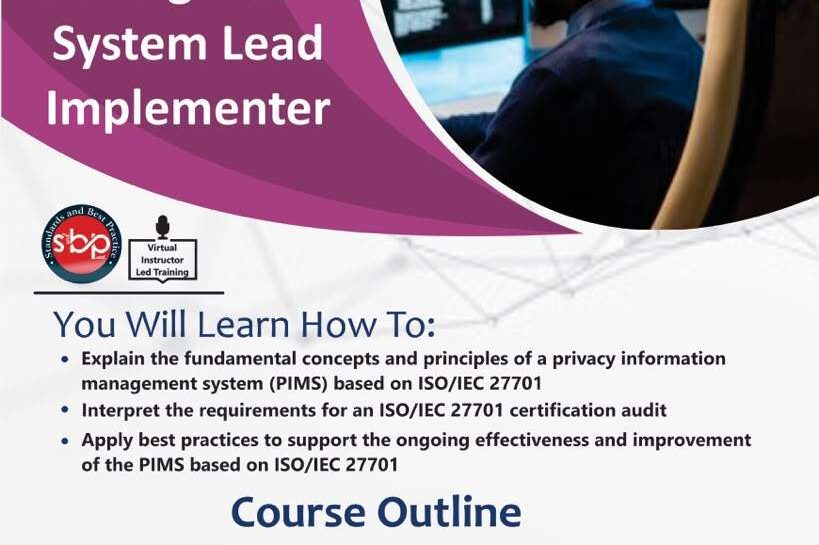
Understanding the standard is one thing; knowing how to turn its requirements into an operating system is another. That is the purpose of Lead Implementer training: to develop the knowledge needed to plan, establish, implement, manage and continually improve a Privacy Information Management System.
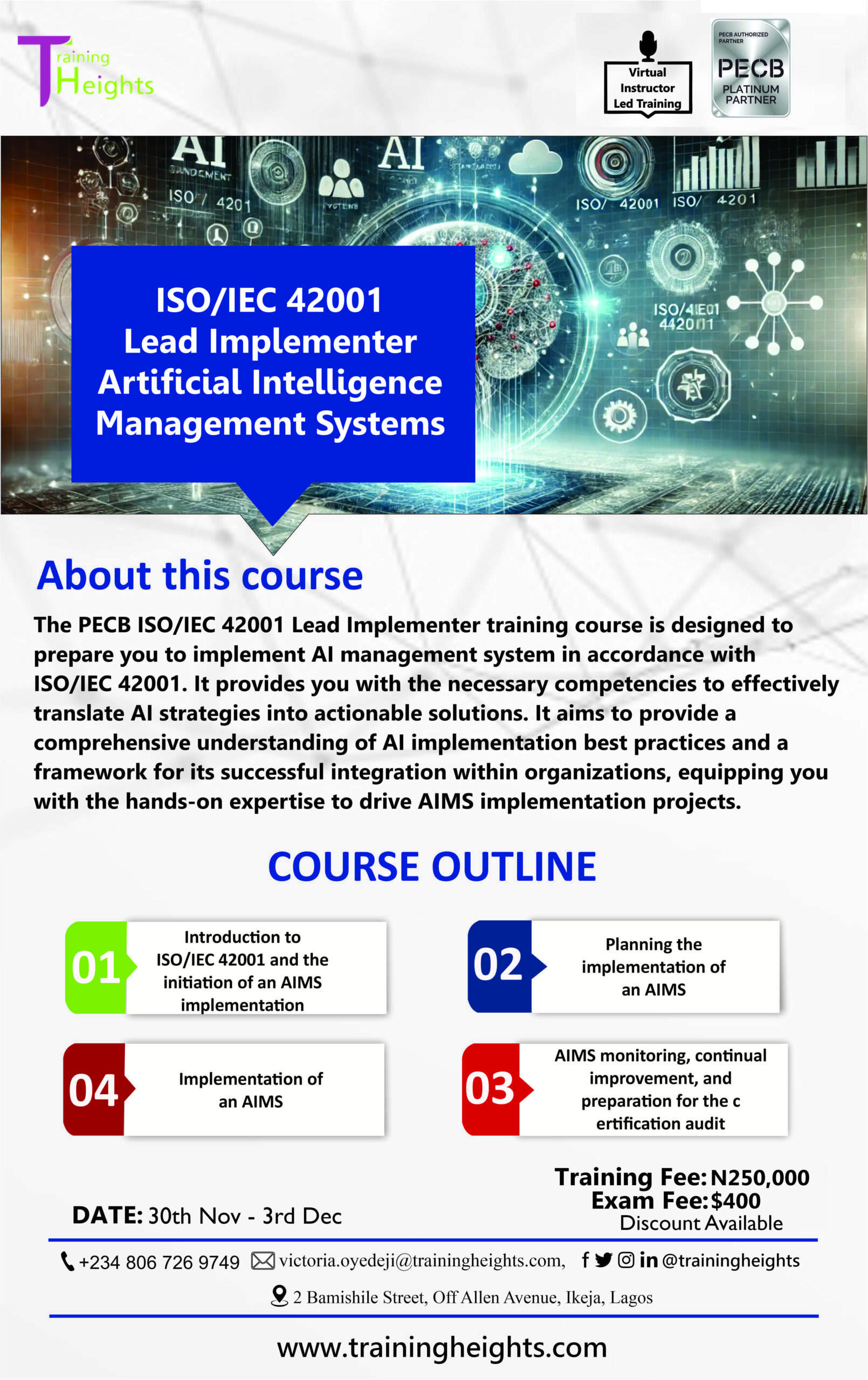
Training Heights Limited is offering its ISO/IEC 27701 Privacy Information Management System Lead Implementer training from 24–27 November 2026. The programme covers the fundamentals of a PIMS, the implementation plan, implementation activities, monitoring, continual improvement and preparation for certification audit.
Course details
Date: 24–27 November 2026
Fee: ₦400,000 (inclusive of certification)
Enquiries and registration: +234 806 726 9749 | victoria.oyedeji@trainingheights.com
Visit: https://trainingheights.com
Whether you are strengthening your organisation’s privacy programme or building your professional capability, the right training can help you move from knowing the requirements to understanding how to implement them. Contact Training Heights to register or request further course information.
Frequently asked questions
What is ISO/IEC 27701?
ISO/IEC 27701 is an international standard that specifies requirements and provides guidance for establishing, implementing, maintaining and continually improving a Privacy Information Management System (PIMS).
What is a Privacy Information Management System (PIMS)?
A PIMS is a management system for governing how an organisation handles personally identifiable information. It brings privacy responsibilities, risk management, controls, monitoring and improvement into a structured approach.
What changed in ISO/IEC 27701:2025?
The 2025 edition is a standalone management system standard rather than an extension to ISO/IEC 27001 and ISO/IEC 27002. It uses the harmonised management-system structure and updates the privacy control framework.
Can ISO 27701 be implemented without ISO 27001?
Yes. ISO/IEC 27701:2025 can be implemented as a standalone PIMS. Organisations may also integrate it with ISO/IEC 27001 or other management systems.
What is the difference between ISO 27001 and ISO 27701?
ISO/IEC 27001 focuses on an Information Security Management System (ISMS). ISO/IEC 27701 focuses on a Privacy Information Management System (PIMS), including the management of privacy risks related to personal information. The systems can be integrated, but they address different management objectives.
Does ISO 27701 replace the Nigeria Data Protection Act?
No. ISO/IEC 27701 is a voluntary international management-system standard. It does not replace the Nigeria Data Protection Act or remove an organisation’s legal obligations. It can help structure privacy management alongside applicable laws.
Who should take ISO 27701 Lead Implementer training?
The training is relevant to privacy and data protection professionals, Data Protection Officers, information security and compliance managers, risk professionals, auditors, consultants and people responsible for implementing or improving a PIMS.
What is the difference between a Lead Implementer and a Lead Auditor?
A Lead Implementer focuses on establishing and improving the management system. A Lead Auditor focuses on planning and conducting audits to assess whether the system meets defined requirements.
📞 Spots are limited – don’t miss out!
Ready to Learn?
Take the next step in your career with this course. Enhance your skills today.
🎥 Virtual, instructor-led sessions – Learn from the best, wherever you are.
🌍 Globally recognized certifications – Boost your credibility worldwide.
🕒 Flexible schedules – Learn at your convenience.
🧑🏫 Expert trainers & hands-on learning – Real skills, real impact.
💰 Affordable pricing & group discounts – Learn more, save more.