

16 November, 2026
AI Deepfakes Are a Business Risk: Build an AI Governance Framework
AI Deepfakes Are a Business Risk: Why Organisations Need an AI Governance Framework
A voice note arrives from the Managing Director. It sounds exactly like him. The instruction is urgent: transfer funds to a supplier before close of business. An employee follows the instruction, only to discover later that the voice was generated by artificial intelligence.
That scenario is no longer just a plot for a technology thriller. AI tools can produce convincing text, images, audio and video, and they can be misused for impersonation, fraud and manipulation. The International AI Safety Report 2026 highlights these risks, including the use of voice clones and deepfakes to deceive people and obtain money.
But the problem is bigger than detecting fake content. What happens when an organisation cannot explain which AI tools its employees are using, what data those tools process, who approved their use or who is accountable when an AI-supported decision causes harm?
That is where an AI governance framework becomes essential.
The real AI risk is not always the technology. It is the absence of oversight.
- An employee may paste confidential customer information into an unapproved AI assistant.
- A recruitment team may rely on an automated screening tool without checking whether its outputs create unfair outcomes.
- A financial institution may use an AI model whose decisions are difficult to explain or challenge.
- A marketing team may publish AI-generated content without a clear review or approval process.
In each case, the organisation has more to manage than the software itself. It needs to understand where AI is being used, the purpose of each system, the people affected, the risks involved and the controls required. AI governance turns these responsibilities into an organised way of working.
What is an AI governance framework?
An AI governance framework is the set of policies, responsibilities, processes and controls an organisation uses to direct and oversee how AI systems are selected, developed, deployed, monitored and improved. It helps answer practical questions: Which uses of AI are acceptable? Who approves high-risk applications? How are risks assessed? What happens when a system produces an unexpected result? How will the organisation monitor performance and correct problems?
A useful framework does not mean banning AI or slowing every experiment. It means enabling innovation with clear boundaries, accountable decision-making and proportionate risk controls.
How does ISO/IEC 42001 help organisations manage AI risks?
ISO/IEC 42001:2023 is an international management system standard for Artificial Intelligence Management Systems (AIMS). It gives organisations a structured way to establish, implement, maintain and continually improve how they manage AI. It applies to organisations that develop, provide or use AI systems; it is not limited to technology companies.
Rather than treating AI governance as a one-off policy document, ISO/IEC 42001 connects it to the organisation’s context, leadership, planning, support, operations, performance evaluation and improvement. In practical terms, implementation includes:
- Defining the scope of the AI Management System and understanding where AI is used.
- Establishing an AI policy, objectives, roles and responsibilities.
- Identifying AI-related risks and opportunities, then assessing and treating those risks.
- Considering impacts on people and other interested parties.
- Putting operational controls and documented processes in place.
- Monitoring the system, evaluating performance, addressing nonconformities and improving it.
The exact controls should reflect the organisation’s context, the AI systems involved and the risks identified. A small business using third-party AI tools will not necessarily need the same controls as a company developing high-impact AI products.
Does ISO/IEC 42001 certify an AI tool?
No. ISO/IEC 42001 is a management system standard for an organisation’s approach to managing AI. It is not a product certificate that guarantees an AI tool is error-free, unbiased or safe in every situation. Organisations may seek independent certification of their AI Management System, but certification is voluntary and is carried out by independent certification bodies, not by ISO itself.
This distinction matters: an organisation can use AI responsibly only when governance is built into the way it selects, deploys and oversees the technology, rather than relying on a label or a vendor’s assurance.
Who should understand ISO 42001 implementation?
ISO/IEC 42001 is relevant to professionals who influence AI decisions or management systems, including IT and information security leaders, risk and compliance professionals, quality managers, data protection teams, consultants, auditors, business leaders and professionals in organisations adopting AI. It is also valuable for people who want to build a career in AI governance and responsible AI implementation.
You do not have to work for an AI developer to be affected. If your organisation uses AI in customer service, recruitment, finance, operations, analytics or content production, someone needs to understand how that use is governed.
How do organisations start implementing ISO/IEC 42001?
Start with visibility, not paperwork. Identify the AI systems in use, including tools adopted informally by teams. Clarify the purpose and boundaries of each use, identify relevant stakeholders, assign ownership and assess the risks. Management must support the work, and the organisation needs a practical plan for policies, controls, training, monitoring and continual improvement.
This is why implementation competence matters. Knowing the name of the standard is different from being able to translate its requirements into a working AI Management System.
Build the skills to implement an AI Management System
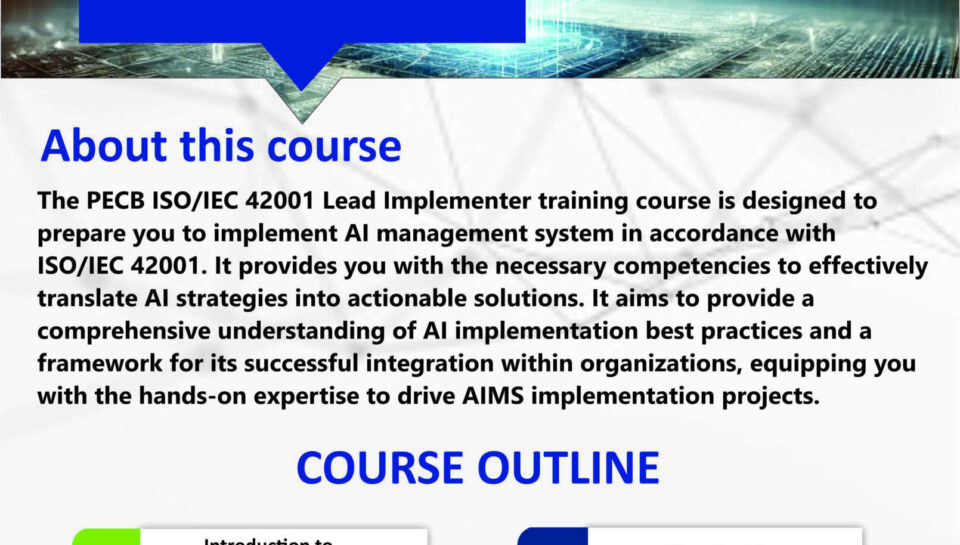
If you are responsible for helping an organisation introduce or strengthen AI governance, Training Heights Limited offers the PECB ISO/IEC 42001 Lead Implementer training. The course is designed to develop the knowledge and practical competencies needed to plan, implement, manage and continually improve an AI Management System in line with ISO/IEC 42001.
The course covers the initiation and planning of an AIMS, implementation, monitoring, continual improvement and preparation for the certification audit. It is suitable for professionals seeking to lead or contribute to AI Management System implementation projects.
Training details: 30 November – 3 December 2026 | Virtual Instructor-Led Training
Training fee: ₦250,000
Exam fee: US$400 (separate from the training fee). Discount available.
Register your interest: Visit trainingheights.com or contact +234 806 726 9749 / victoria.oyedeji@trainingheights.com.
Take the next step towards becoming a professional who can turn AI governance requirements into practical organisational controls. Enquire about the ISO/IEC 42001 Lead Implementer training at Training Heights.
Frequently asked questions about AI governance and ISO 42001
What is the purpose of an AI governance framework?
It establishes how an organisation directs, approves, monitors and improves its use of AI. It clarifies responsibilities, sets acceptable-use boundaries and helps manage risks across the AI lifecycle.
What are the main risks of using AI in business?
Risks can include inaccurate or harmful outputs, privacy and data protection issues, security threats, bias or unfair outcomes, lack of transparency, intellectual property concerns, regulatory exposure and misuse such as deepfake-enabled fraud.
What is ISO/IEC 42001 in simple terms?
It is an international standard that sets requirements for establishing, implementing, maintaining and continually improving an Artificial Intelligence Management System.
Is ISO 42001 only for technology companies?
No. It can apply to organisations of different sizes and sectors that develop, provide or use AI systems, including organisations that use third-party AI tools.
What is the difference between ISO 42001 and AI ethics?
AI ethics describes principles and values for responsible AI. ISO/IEC 42001 provides management system requirements that help an organisation translate its commitments into policies, responsibilities, processes, controls and continual improvement.
Does ISO/IEC 42001 guarantee that AI will not make mistakes?
No. It does not guarantee error-free AI. It helps organisations establish processes to identify, assess, manage and monitor AI-related risks and improve their controls.
What does an ISO 42001 Lead Implementer do?
A Lead Implementer helps an organisation plan, establish, implement, manage and continually improve an AI Management System aligned with ISO/IEC 42001.
📞 Spots are limited – don’t miss out!
Ready to Learn?
Take the next step in your career with this course. Enhance your skills today.
🎥 Virtual, instructor-led sessions – Learn from the best, wherever you are.
🌍 Globally recognized certifications – Boost your credibility worldwide.
🕒 Flexible schedules – Learn at your convenience.
🧑🏫 Expert trainers & hands-on learning – Real skills, real impact.
💰 Affordable pricing & group discounts – Learn more, save more.