

29 October, 2026
How to Use AI Safely at Work: Beyond ChatGPT
Beyond ChatGPT: How to Use AI Safely at Work Without Exposing Your Business
Ask someone to name an artificial intelligence tool and there is a good chance they will say ChatGPT. It has made AI feel accessible: people use it to draft emails, summarise documents, brainstorm campaigns and explain difficult topics. But ChatGPT is not the whole of artificial intelligence, and using a popular tool does not automatically make an AI task safe.
Businesses also use AI-powered features in search engines, office software, customer service platforms, recruitment tools, analytics systems and cybersecurity products. The important question is no longer simply, “Which AI tool should we use?” It is, “How do we use AI without exposing our data, misleading customers or making decisions we cannot explain?”
What does safe AI use actually mean?
Safe AI use means choosing appropriate tools, protecting personal and confidential information, checking outputs, understanding limitations and keeping people accountable for decisions. It also means considering fairness, security, transparency and the possible effects an AI system may have on employees, customers and other people.
For example, asking an AI assistant to improve a generic meeting invitation is very different from uploading a customer database, employee records, unpublished financial results or a confidential contract. Before entering information, check your organisation’s rules and the tool’s approved-use terms. If you are unsure whether data can be shared, do not paste it into a public AI service.
Five practical ways to use AI more safely at work
1. Keep confidential information out of unapproved tools
Do not submit passwords, access keys, personal records, client details, sensitive business plans or confidential documents unless the tool and use case have been approved. Remove identifying details where possible and use an organisation-approved environment.
2. Verify answers instead of trusting confident wording
Generative AI can produce convincing but incorrect answers, invented references or outdated information. Treat its output as a draft, not proof. Check facts against reliable sources, test calculations and confirm legal, financial, technical or safety-critical advice with a qualified person.
3. Match the tool to the task
Do not assume every AI product has the same purpose, privacy settings or safeguards. Review what the tool does, what information it processes, who can access the output and whether the provider’s terms fit your organisation’s needs.
4. Keep a human responsible for important decisions
AI can support analysis, but a person should review consequential decisions such as hiring, credit, healthcare, disciplinary action or customer eligibility. Check for bias, missing context and unfair outcomes, and provide a way to challenge decisions when appropriate.
5. Create clear rules and review them regularly
A short workplace AI policy should explain which tools are approved, what data may be entered, when human review is required, how staff report errors or incidents, and who owns each AI use case. Train employees and revisit the rules as tools, risks and business needs change.
Is ChatGPT the only AI tool?
No. ChatGPT is a generative AI assistant, but AI is a much wider field. It can be embedded in recommendation systems, fraud detection, forecasting, translation, image analysis, automation and customer support. Some tools generate content; others classify information, identify patterns or help make predictions.
That distinction matters because different AI uses create different risks. A tool that drafts a social media caption may need a different level of review from a system that screens job applicants or supports a high-impact business decision. Organisations should assess the use case, not just the brand name of the software.
How does ISO/IEC 42001 help organisations manage AI?
ISO/IEC 42001:2023 is an international standard for establishing, implementing, maintaining and continually improving an Artificial Intelligence Management System (AIMS). Rather than focusing on one chatbot or product, it gives an organisation a structured way to manage AI-related risks and responsibilities across its activities.
In practice, this means moving from informal individual habits to organisation-wide governance: defining responsibilities, assessing risks and impacts, setting controls, documenting decisions, monitoring performance and improving the system over time. ISO/IEC 42001 does not make every AI output automatically correct or risk-free; it helps organisations build a repeatable management approach for responsible AI use.
Who should learn AI management and governance?
AI governance is relevant to professionals responsible for technology, information security, compliance, risk, quality, data, operations, consulting and business transformation. It is also useful for managers who need to introduce AI while maintaining oversight and accountability.
Build practical AI governance skills with Training Heights
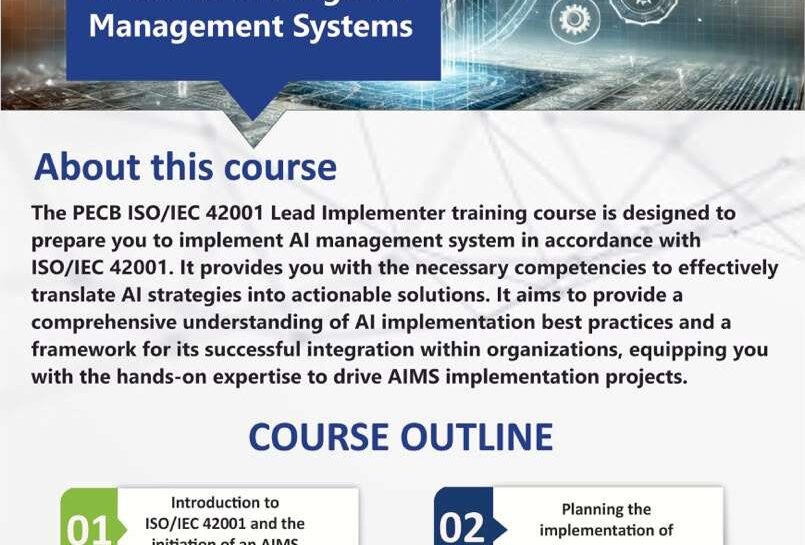
If your organisation is moving beyond experimenting with ChatGPT and wants a more structured approach to AI, consider the ISO/IEC 42001 Lead Implementer training from Training Heights Limited. The course is designed to help participants understand the standard and plan, implement, manage, monitor and continually improve an AI Management System.
Training details: 23–26 November 2026 | Training fee: ₦250,000 | Exam fee: US$400. Confirm current availability, inclusions and payment details with Training Heights before registering.
The training is suited to professionals who want to help their organisations turn responsible AI principles into practical policies, processes, risk controls and implementation activities.
To enquire or reserve a place, visit the Training Heights course page: https://trainingheights.com/event/ai-management-iso-42001-li/ or call +234 806 726 9749. You can also email info@trainingheights.com.
Frequently asked questions
How can I use ChatGPT safely at work?
Use an approved account and follow your organisation’s AI policy. Do not enter confidential or personal information without authorisation, verify important claims, and have a person review outputs before they are shared or used for decisions.
Can AI give wrong information?
Yes. Generative AI can produce plausible-sounding but inaccurate statements, references or calculations. Verify important outputs using reliable sources and expert review.
What information should I never put into an AI chatbot?
Avoid entering passwords, access tokens, sensitive personal data, confidential customer records, protected health or financial information, and unpublished company information unless your organisation has explicitly approved the tool and use.
What is ISO/IEC 42001?
ISO/IEC 42001:2023 is an international standard that specifies requirements for an Artificial Intelligence Management System. It helps organisations manage AI-related risks and opportunities through defined governance, processes and continual improvement.
Does ISO 42001 apply only to companies that build AI?
No. It can be relevant to organisations that develop, provide or use AI-based products and services. The appropriate scope depends on the organisation and how it uses AI.
What is the difference between AI safety and AI governance?
AI safety focuses on preventing or reducing harmful or unreliable outcomes. AI governance is the broader system of responsibilities, policies, risk processes, oversight and monitoring that helps an organisation manage AI use responsibly.
How much is Training Heights’ ISO 42001 Lead Implementer training?
The supplied course flyer lists a training fee of ₦250,000 and an exam fee of US$400 for the 23–26 November 2026 session. Confirm the latest details with Training Heights before booking.
Responsible AI is not achieved by banning every tool or trusting every output. It starts with knowing what the tool is being used for, what could go wrong and who is accountable. ChatGPT may be the first AI tool many people try, but safe AI use is an organisation-wide responsibility.
📞 Spots are limited – don’t miss out!
Ready to Learn?
Take the next step in your career with this course. Enhance your skills today.
🎥 Virtual, instructor-led sessions – Learn from the best, wherever you are.
🌍 Globally recognized certifications – Boost your credibility worldwide.
🕒 Flexible schedules – Learn at your convenience.
🧑🏫 Expert trainers & hands-on learning – Real skills, real impact.
💰 Affordable pricing & group discounts – Learn more, save more.